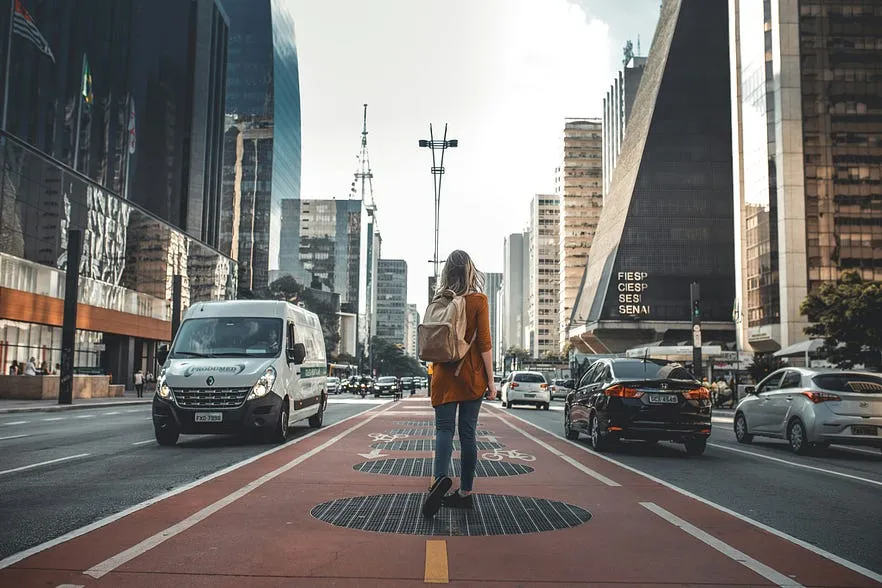
Posted on Substack on December 25, 2025 ------ You know that feeling when you turn down a street you've never been on before, and suddenly you're like, "Wait, where even am I?" That rush of uncertainty mixed with possibility? That's my favorite part of walking around any city. It's a mini-adventure hiding in plain sight.
The whole "getting lost" thing isn't really about panicking because you don't know where you are. It's more like... allowing yourself not to have a plan for every moment. Sure, hit the famous landmarks if you want—they're famous for a reason. But leave some time for wandering without a route—no specific destination. Just walking and seeing where you end up. Photo by Guilherme Stecanella on UnsplashI learned this over 28 years in Washington, DC. My best weekends were the ones where I'd just pick a direction and go. Sometimes I'd walk through the same neighborhoods again to see what changed—a new mural that wasn't there last time, some cafe that just opened, a park that finally got finished. Other times I'd end up somewhere completely new, following a promising-looking alley or chasing interesting light into unfamiliar territory. Spring, summer, fall, winter—the city kept showing me different versions of itself, like it was daring me to keep exploring.
I lived in the Atlas District (also known as the H Street Corridor), and I walked through the whole neighborhood—including NoMa—watching it transform beautifully over those years. New murals appearing on walls, empty lots becoming parks, streets evolving while still keeping their character. It was like watching the city grow and change in real time, always revealing something new on familiar routes.
After 28 years at the same job, I got laid off. That's when I moved back to my hometown, a small rural Appalachian town. It's beautiful—the mountains surrounding the town are gorgeous, especially in winter, when they're blanketed in snow. There's something wondrous about that view. But I really miss walking around and exploring the city the way I used to. There's just not much to discover on foot here. Maybe once I get my driver's license, I can drive to nearby towns and explore them. Who knows? Until then, I'm holding onto those memories and dreaming about my next urban adventure.
The Stuff You Actually Find
When you're not on a tight schedule, rushing from landmark to landmark, you notice things differently. The way light hits a building at a certain time of day. Some tiny bookshop with a cat in the window. Street art on a random alley wall that feels like discovering a treasure map. A park where actual locals hang out instead of tour groups—the kind of scene that makes for a really good photo and feels like you've cracked a code.
That's where the real discoveries are. Not because they're secret or hard to find, but because they're just... existing in the spaces between all the famous landmarks, waiting for someone curious enough to venture off the main drag.
And honestly? Finding those hidden gems—the places most people don't know about—is one of my favorite things about exploring cities. Something is thrilling about stumbling onto a spot completely by accident and realizing you've found something special that isn't on any map or in any guidebook. It's like the city is sharing a secret with you, rewarding you for being brave enough to wander.
I found so many spots like this in DC. There was this community garden hidden behind H Street that would absolutely explode with color every spring—like discovering a secret oasis in the middle of the city. Blagden Alley, with its incredible street art that most tourists never stumble upon, reveals new murals with each visit. A breakfast spot with a fantastic menu that hardly anyone seemed to know about, the kind of place that made you feel like an insider. This one specific angle at the Tidal Basin where the monuments reflected perfectly in the water, but only if you went at the right time and knew exactly where to stand. No tour guide ever mentioned it. It was mine to discover.
Vintage shops that feel like digging through your cool aunt's attic. Gardens tucked behind gates you'd walk right past if you weren't paying attention. Every city has them.
When You Stop Optimizing Everything
We're so used to planning everything, right? Fastest route. Best value. Don't waste time. But walking without a plan is the opposite of that, and honestly, that's the point.
Pick a direction. Turn when something looks cool. Follow interesting light or weird architecture. Stop whenever you feel like it. There's no such thing as a wrong turn when you're not actually trying to get anywhere specific.
Keep your phone charged, sure. But maybe don't check your location right away every time you feel a little unsure where you are. That slight "hmm, where am I?" feeling? That's what keeps you actually looking around instead of just walking on autopilot.
What You See From the Ground
From a car or bus, cities are just... scenery going by. On foot, you're actually in it. You notice tile patterns, the way shadows make shapes on sidewalks, textures in old brick, and peeling paint. You're moving at people speed through people-sized spaces, and suddenly everything could be a photograph—doorways, puddle reflections, the way strangers interact in public.
Residential neighborhoods tell you way more about a place than any tourist area. You see how people actually live. The playgrounds. The corner stores. The cafes where they meet up with friends. All the everyday details visitors usually miss.
Looking Through the Camera
As someone who's into photography, wandering around lost is literally how I get my best shots. The photos that actually capture what a place feels like aren't at those famous viewpoints where everyone's crammed together taking the same picture. They're in unexpected moments—two elderly people on a bench in some forgotten plaza, morning light coming through market canopies, old buildings next to new ones when you turn a random corner. The shots that make people ask, "Wait, where is that?"
In DC, I watched the same neighborhoods transform entirely through the seasons. Capitol Hill row houses looked totally different, framed by cherry blossoms versus covered in snow. Shaw's murals changed depending on whether it was harsh summer noon light or those low golden winter afternoons. Georgetown's cobblestone streets—which everyone photographs—showed me completely new compositions when I'd go at dawn, or after rain, or when they were covered in October leaves. Same places, infinite variations. Each season was like getting a whole new city to explore.
You can see some of my favorite shots from wandering around DC (and other cities) on my Instagram: @technogeek75
When you're just wandering with no real agenda, you're way more tuned in to visual stuff. You're hunting for moments. You notice the color schemes that define different neighborhoods. You catch moments as they happen—someone arranging flowers in their shop, kids playing in a fountain, a residential street that's perfectly symmetrical. Your camera becomes a way of really seeing a place, not just proving you were there.
The best part? These photos tell stories that guidebook shots can't. They're yours because you found them through your own curiosity and willingness to take that weird turn down that sketchy-looking alley that turned out to be amazing.
Getting Intentionally Lost
If wandering with zero structure sounds too chaotic, here's some loose guidance to make it feel more like an adventure and less like you're actually going to end up stranded:
Start somewhere you know, so you can always get back. Give yourself a time limit—an hour, a whole afternoon, whatever. Bring water and comfortable shoes. Then... go hunting.
Take side streets instead of main roads—that's where the real stuff is. Follow buildings that look interesting or mysterious. If you see stairs going up or down, take them (you never know what's at the top of that hill or at the end of that hidden passage). Notice where locals are heading and follow. Say yes to checking out that park, alley, or neighborhood you'd usually walk past. Treat every turn like it might lead to something unexpected.
You're not trying to get completely, hopelessly lost. You're just making space for random discoveries. Think of it as urban exploration lite—all the thrill of discovery, none of the trespassing.
The Stories (and Photos) You'll Tell
Nobody wants to hear about waiting in line for an hour at some famous restaurant everyone goes to. But that random place you stumbled into where the owner made you try their family recipe? The tiny museum you found by accident that turned out to be super interesting? That perfect golden hour shot you got in some alley you'd never have seen if you'd stuck to the main streets? The time you followed a cat down three flights of stairs and discovered an entire underground art gallery?
Those are the things worth talking about, the photos worth keeping. Those are what turn a trip to a city into actually experiencing the place. Those are the stories that make people lean in and say, "Wait, how did you even find that?"
And here's the thing—you can't plan those moments. You can't Google Map your way to serendipity. You have to be willing to take the weird turn, follow the interesting light, trust your instincts when something catches your eye. That's where the magic lives.
The Thing Is...
Every city—even your own—has these moments just sitting there waiting—adventures hiding in plain sight. You have to be willing to get a little lost to find them.
So next time you're walking anywhere, take a different route. Turn when you'd usually go straight. Follow that interesting-looking street even though you have no idea where it goes. Say yes to the detour. See what happens.
The good stuff isn't hiding. You've just been too busy following directions to notice it. The city's been trying to show you its secrets all along—time to let it.
Further Reading & Tips
Want more ideas on getting lost and exploring cities? Check out these articles: